How does a fuel nozzle work?
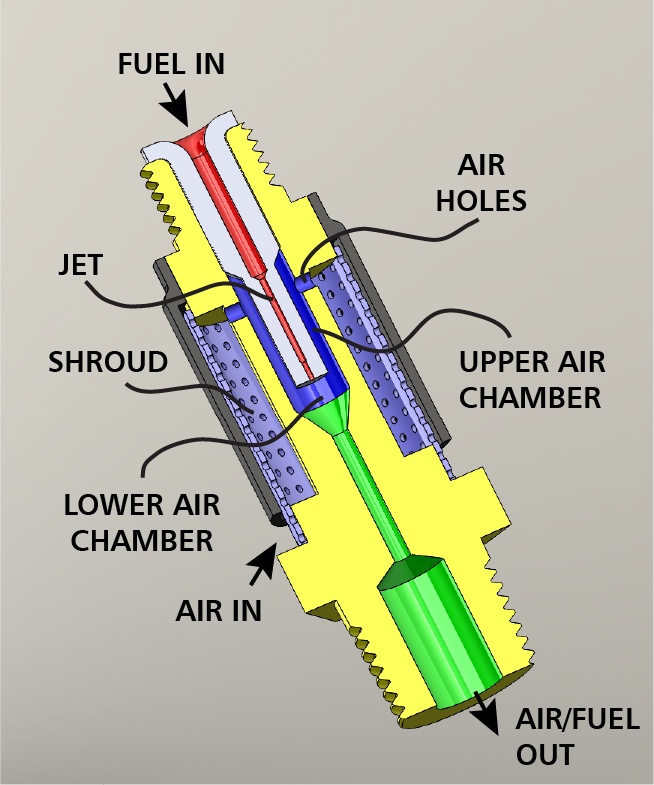
A fuel nozzle isn't as simple as it first appears. Fuel from the fuel system is introduced into the top of the nozzle, and flows through the carefully-sized metered orifice in the jet. At the bottom of the jet, that fuel is mixed with air in an air chamber, and the atomized air/fuel mixture is then sprayed out the bottom of the nozzle assembly. Inside the air chamber is where various debris can hide and then clog up the nozzle when you least expect it.
The pictures in this discussion show nozzles from a normally aspirated Continental, such as an IO-520 or IO-470, but all nozzles work similarly.
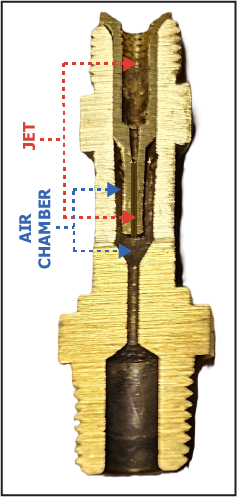
Here's a picture of a fuel nozzle that's been sawed in half. In this picture, the fuel flows in from the top, and through the jet. The diagrams below show the relative sizes of the holes in the nozzle.
The fuel flows out the bottom of the jet, and mixes with air that flows in from the outside into the air chamber surrounding the jet. There's a set of holes through which the air flows (these are visible in the next picture), and the air and fuel mix together in the larger section of the air chamber at the bottom of the jet.
There's a screen and a shroud around the outside, which are also visible in the next picture.
Generally, the nozzle isn't disassembled at cleaning time. The screen and shroud can be removed (they're pressed on), but removing the jet damages it. It's important to not damage the metered orifice, because it's very carefully calibrated in order to balance the fuel flows. But we still want to clean any and all debris from the nozzle, even without disassembling it.
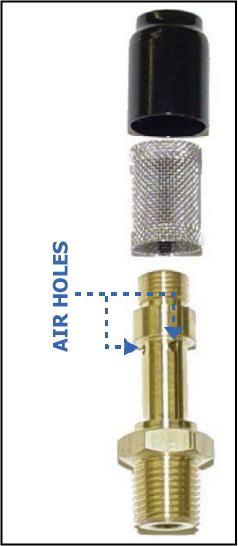
Here is a view of the injector body with the screen and shroud removed. You can't remove the jet without damaging it, so we aren't going to show that.
Note the small holes just below where the shroud is mounted. Air flows into the nozzle via those holes, and into the air chamber.
The screen is very fine – only air is meant to go through it, and it effectively keeps out any debris.
But – as we'll see – it also helps to keep debris in!
How does a fuel nozzle get contaminated?
We know fuel nozzles get contaminated, but how does this occur? After all, there are several screens in the fuel system that are designed to prevent this. There's the fuel strainer (part of the airframe), there's a screen in the fuel injection control assembly, and there's also a screen in the flow divider (spider) on the top of the engine. Generally, these defenses should combine to prevent any contamination of your nozzles – but it can still happen. Some sources of contamination include:
a disintegrating rubber hose;
a small shard of metal resulting from corrosion in a wet wing fuel tank;
a small particle of sealant from work on the fuel system;
the disintegration of the diaphragm in the flow divider itself, which misses all of the screens.
As we can see, despite the various screens, contamination happens, and when it does, it's nearly impossible to fix using the method of cleaning employed by most mechanics. In fact, soaking the nozzle in solvent also serves to loosen up any deposits, which can actually add to the total amount of contamination in the nozzle.
Why are current methods ineffective?
Let's imagine we have a nozzle with a piece of debris in it, and we try to blow out the nozzle using a blow gun with compressed air. What exactly is happening? The following illustration will aid our understanding.
Blowing from the top
The last thing we want to do is blow through the nozzle from the top. If there is any type of foreign substance in the top of the nozzle, at the opening of the jet, we absolutely don't want to blow it through or even towards the metered orifice. The jet is shaped like a funnel, and blowing air down from the top blows whatever is in the nozzle farther down into the narrow part of the jet. The better choice would be to blow through the jet in the other direction – from inside of the nozzle assembly – so that any deposits or debris are blown out, not in.
Blowing from the bottom
Now suppose we were to blow air into the assembly from the bottom. Where does the debris go now? It certainly doesn't go out of the nozzle assembly. It's very unlikely to come out through the small metered orifice at the bottom of the jet. Instead, the debris is much more likely to go into the upper section of the air chamber. It will get blown up around the outside of the jet, and possibly go through or clog up the air holes in the barrel. If it does go through those holes, it becomes trapped by the screen on the outside of the nozzle. But, more likely than not, it will just get wedged or impacted into the upper air chamber, and will stay there until engine vibration and air flow shakes it loose, where it will once again plug up the nozzle exit on a future flight and cause that cylinder to misfire.
In addition, the air holes on the side of the barrel are much, much bigger than the metered orifice in the jet – so when blowing air up through the bottom of the nozzle assembly, the vast majority of the pressurized air will escape through the air holes and out through the screen. A very minimal amount of compressed air will escape out through the jet, meaning any contamination in the jet itself will almost certainly not be removed.
As we can see, it's virtually impossible to blow any debris out of the nozzle assembly using just a blow gun. We can only succeed in blowing the debris further into the nozzle assembly, where it will remain trapped.
So what now?
How does NozzleFlush work?
The only way to have a chance of blowing any debris completely out of the nozzle is to blow inwards from the sides – through the air holes in the barrel of the nozzle, forcing air and debris out through the air chamber, around the jet, and out the bottom of the nozzle assembly. This is impossible to do with a blow gun, because a blow gun can't pressurize air into all of the holes in the barrel at the same time. This is where the (Patent Pending) NozzleFlush tool comes in.
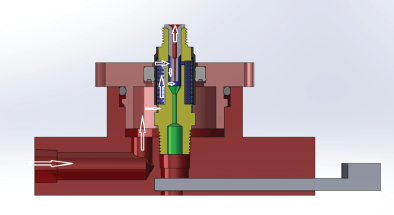
The NozzleFlush works by sealing the outside of the nozzle into a chamber that is then pressurized with air or fluid, causing it to be directed through all of the air holes around the barrel of the nozzle equally and simultaneously. This is the only way to get air (or fluid) to flow through the full air chamber and out the bottom of the nozzle assembly, along with any contamination or debris it collected on the way. In addition, by inserting the slide, you can block the air or fluid from exiting at the bottom, instead forcing it upwards through the jet. This would simply not be possible with just an air gun.
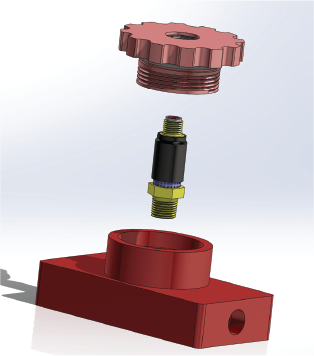
Cleaning the air chamber
Here is a cross-section view of the NozzleFlush. The white arrows show the flow of air or fluid through the nozzle. Since the full circumference of the nozzle is sealed inside the NozzleFlush tool, the flow is directed into the air holes and through the air chamber area, where it then carries any debris out the bottom of the nozzle assembly.
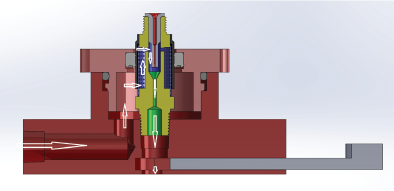
Cleaning the jet
The jet has a very small metered orifice. If it's clogged, you'll be able to see that contamination by using a magnifier. In any case, we don't want to blow any contamination from the top of the nozzle down into the air chamber. If there is contamination of the jet, we want to blow that out, not in. To do this, simply insert the nozzle into the NozzleFlush tool as before, and use the slide to plug the exit hole at the bottom. This will force the air or fluid upwards out through the jet and will blow the contaminants out rather than in.